
How to Play Truth or Dare: Rules, Setup, and Ideas That Actually Work
Truth or Dare is a social party game where players take turns choosing between answering an honest question (truth) or completing a challenge (dare). There is no winner the goal is laughter, conversation, and a little friendly pressure. It works at sleepovers, parties, family game nights, and even over video call.
Basic flow:
- Gather 3 to 8 players and sit in a circle
- Choose who goes first
- Ask someone: “Truth or dare?”
- They choose truth → answer a question honestly
- They choose dare → complete a challenge
- That player becomes the next asker — repeat until done
What You Need to Play
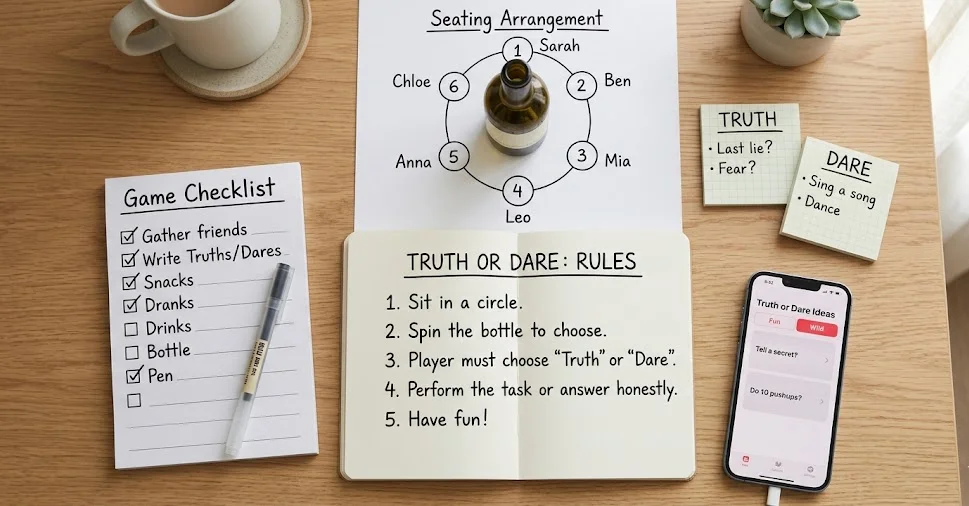
One of the reasons Truth or Dare has been popular for generations is that it needs almost nothing to get started.
| What You Need | Details |
| Players | At least 3 (4–8 is ideal) |
| Space | Anywhere you can sit in a circle |
| Prep time | 5 minutes for ground rules |
| Equipment | Optional: a bottle to spin, a question list, or a generator |
A Truth or Dare generator is especially helpful when the group starts running out of ideas mid-game. [Internal link: Truth or Dare Generator]
How Many People Can Play?
| Playes | Experience |
| 2 | Works, but loses the group dynamic |
| 3–5 | Fast-paced and personal |
| 6–8 | Ideal everyone stays engaged |
| 9–10 | Still fun with a clear turn order |
| 10+ | Use a strict circle format so no one is skipped |
Step 1: Set Ground Rules Before Anything Else
Most games that go wrong skipped this step. Two minutes of agreement before the first question prevents 20 minutes of awkwardness later.
Before the first round, agree on:
- Off-limit topics: Family problems, health issues, relationships, finances. Let the group decide together, not just the loudest person in the room.
- Dare boundaries: No physical risk, no involving strangers, no posting anything online without everyone’s full agreement, no leaving the space unsupervised.
- Skipping rules: Can players decline? If yes, what happens? Common options: sit out one round, answer a different question, or complete a light forfeit the group agrees on beforehand.
- Dare time limits: 60 seconds is a fair default for most dares. Set this before the game starts.
- Repeat rule: No asking the same truth or giving the same dare twice. Keeps things creative.
For larger groups or family settings, write these down. A visible reference stops arguments before they start.
Step 2: Choose Who Goes First
Any of these methods work:
- Spin the bottle: The classic option. Whoever it points to starts.
- Youngest player: Simple and argument-free for family groups.
- Volunteer: Ask who wants to kick things off.
- Random picker: Use a free app or draw names from a bowl.
It does not matter which method you use what matters is that everyone agrees before the game begins.
Step 3: How Each Round Works
The starting player looks at anyone in the group and asks: “Truth or dare?” The chosen player says either truth or dare before hearing the question or challenge. No switching after. The asker gives a question. The chosen player must answer it honestly. No half-answers, no deflecting.
The asker gives a challenge. The chosen player must complete it within the agreed time limit. After completing the truth or dare, that same player becomes the new asker. They pick someone new. The cycle continues until the group decides to stop there is no fixed endpoint.
What Happens if Someone Refuses?
Apply whatever the group agreed to before the game. Common options:
- Answer a different truth question instead
- Complete a lighter group-chosen forfeit
- Sit out for one full round
The point is not punishment it is just keeping the game moving. Never pressure anyone past what they are comfortable with. A skip should feel like a light moment, not a big deal.
How to Give a Good Truth Question
The quality of Truth or Dare depends almost entirely on the quality of what gets asked and assigned. Here is the difference between questions that get real answers and ones that get shrugs.
Weak question: “Have you ever been embarrassed?” Strong question: “What is the most embarrassing thing that has happened to you in front of someone you were trying to impress?”
The strong version gets a story. That is what makes the game interesting.
Formula for a good truth question:
- Specific enough to get a real answer
- Open-ended enough to get a story, not just yes or no
- Surprising without being invasive
Truth Question Ideas
Fun, revealing questions that spark honest conversations and help people learn surprising things about each other.
Light and Funny
- What is one thing you own that you are secretly a little embarrassed about?
- What is the most unusual food combination you actually enjoy?
- Have you ever waved back at someone who was not actually waving at you?
- What is the worst excuse you have ever given to get out of something?
- What is something you thought would be hard that turned out to be surprisingly easy?
Revealing but Safe
- What is the most ridiculous thing you have ever convinced yourself was a good idea?
- What is a strong opinion you have that most people in this room would probably disagree with?
- If someone went through your camera roll right now, what is one photo that would need explaining?
- What habit are you genuinely trying to break right now — and how is it going?
- What is one thing about yourself that took you a long time to actually like?
Conversation-Starting
- What is the nicest thing a stranger has ever done for you?
- What is something you wish you had said to someone but never did?
- If you had to describe yourself in three words, what would you pick — and would this group agree?
- What is the last thing that made you laugh so hard you could not stop?
- What skill do you wish you had learned earlier in life?
Family-Friendly (All Ages)
- What is your favorite memory from this year so far?
- What is one thing on your bucket list you have not told many people about?
- What is the funniest thing that has happened to you recently?
- If you could only eat one meal for a month, what would it be?
- What is a goal you have been quietly working toward?
How to Give a Good Dare

The best dares create a moment something the group will bring up for the rest of the night. They are slightly uncomfortable but completely doable. They are never dangerous, and they are never designed to humiliate. The test for a good dare: Would you laugh if you had to do it yourself? If yes, it probably works. What makes dares fall flat:
- Too easy no reaction from the group
- Too vague the player does not know what to actually do
- Too risky anything physically dangerous or socially damaging
- Too mean embarrasses rather than entertains
Dare Ideas
Lighthearted and entertaining challenges that encourage laughter, creativity, and memorable moments with friends.
Silly and Easy
- Speak in an accent for the next three rounds
- Do your best impression of the person sitting to your left
- Narrate everything you do for two minutes like a wildlife documentary
- Try to lick your elbow for 30 seconds
- Wear socks on your hands for the next two rounds and do not mention them
Funny and Slightly Awkward
- Call a family member, tell them you have exciting news the news is that you saw a cool bird today
- Do 15 seconds of interpretive dance to a song the group picks
- Let someone style your hair however they want you wear it for the next 10 minutes
- Stage-whisper everything you say for the next two rounds
- Describe your last dream in as much detail as you can remember, out loud, right now
Performance-Based (Great for Groups)
- Teach the group a handshake you invent on the spot everyone must learn it
- Do impressions of each person in the group until someone guesses who you are imitating
- Lead the group in a 60-second workout you make up yourself
- Give a 30-second motivational speech about a completely ordinary object in the room
- Pretend to be a game show host and introduce the next round dramatically
Family-Friendly Dares (All Ages)
- Do your best animal impression group guesses which animal
- Draw something on a piece of paper in 20 seconds and let the group guess what it is
- Talk like a robot for the next two rounds
- Do your best funny walk across the room
- Make up a short poem about the person to your right, right now
Common Mistakes That Ruin the Game
- Skipping ground rules. The games that turn uncomfortable almost always skipped this step. Fix it before the first question.
- Targeting the same person repeatedly. If every question or dare goes to one player, it stops feeling like a game. Spread attention evenly.
- Dares that involve people outside the group. Calling someone who did not agree to be part of the game, or posting content involving others, creates real-world problems that outlast the session.
- Letting dares escalate without limits. There is a natural group pressure to keep raising stakes. That is fun up to a point. The group should feel comfortable saying “let’s keep it at this level” before things go somewhere nobody actually wanted.
- Focusing on winning or catching people out. Truth or Dare is not a competitive game. The moment it starts feeling like a trap, the fun disappears.
- Making skips a big deal. If someone passes, apply the agreed consequence and move on quietly. Drawing attention to it creates pressure and ruins the mood.
Fun Variations to Try

If your group has played Truth or Dare before, a few simple rule changes can make the game feel fresh again. These variations add structure, keep everyone involved, and often create even more laughs than the standard format.
- Spin the Bottle Format: The asker does not choose who gets the truth or dare; they spin a bottle instead. Whoever it lands on goes next, removing any feeling of being deliberately targeted.
- Card Version: Write truth questions on one color of index card and dares on another. Shuffle the cards and draw them randomly. Nobody has to think of prompts on the spot, making it ideal for larger groups.
- Category Rounds: Dedicate one full round to truths and the next to dares. This prevents players from always choosing the same option and encourages more variety throughout the game.
- Speed Round: Players have only 10 seconds to answer a truth or start a dare. The fast pace keeps energy high and often leads to hilarious, unfiltered responses.
- Theme Night: Choose a theme such as movies, travel, school memories, childhood, or food. Every truth question and dare must relate to that theme, creating a more creative and cohesive experience.
- Timer Dares: Every dare must be completed within 60 seconds, with no exceptions. Even simple challenges become much funnier when the clock is ticking and everyone is watching.
Playing Over Text or Online
Truth or Dare works well over video call and text with minor adjustments.
Video calls: Most in-person dares translate directly performances, impressions, phone calls on speaker, dances. The circle dynamic shifts slightly but the core game is identical.
Over text: Truth questions work exactly the same. Dares need adapting sending a specific message to someone, changing a profile photo for an hour, recording a voice note, or posting something the group pre-agrees on. A generator built for remote play makes both formats much easier.
Safety and Respect The Non-Negotiables
Truth or Dare is supposed to feel a little risky. That edge is part of what makes it fun. But there is a clear difference between playful discomfort and actual discomfort.
- Never pressure anyone. If someone declines, apply the agreed consequence and move on. Do not make it into a moment.
- Keep it in the room. Dares that involve posting online, sharing screenshots, or bringing in people who did not consent to play create problems that last beyond the game.
- No physical risk. Anything that could cause injury, get someone in trouble, or leave a lasting consequence is off the table regardless of what anyone agrees to in the moment.
- Match the content to the group. A mixed-age family gathering needs different questions than a group of close friends. Read the room and adjust accordingly.
- Respect every no. Participation should always feel voluntary. The moment it stops feeling that way, the game has gone too far.
FAQs
How do you play Truth or Dare?
Players sit in a circle and take turns asking each other, “Truth or Dare?” The chosen player either answers a question honestly (truth) or completes a challenge (dare). There is no winner the game continues until the group decides to stop.
How many people do you need to play Truth or Dare?
You need at least three players for it to feel like a proper group game. Two people can play, but it loses the audience dynamic that makes dares funnier. The sweet spot is usually four to eight players.
Can you switch from truth to dare after you’ve chosen?
No. Once you choose truth or dare, that is your choice for the round. Switching after hearing the question or dare is generally not allowed and should be covered in the group’s house rules before the game begins.
What happens if someone refuses a dare?
Apply whatever consequence the group agreed on beforehand, such as answering an alternative truth question, sitting out one round, or completing a lighter forfeit. Nobody should be pressured into doing something they genuinely do not want to do.
Is there a winner in Truth or Dare?
No. Truth or Dare is a social game designed for fun rather than competition. The goal is to create laughter, conversations, and memorable moments not to score points or reach a finish line.
Is Truth or Dare appropriate for kids?
Yes, when the content is age-appropriate. The game format works well for all ages. For younger players or family groups, use lighter questions and playful dares. A family-friendly question generator can make choosing suitable prompts easier. [Internal link: Family-Friendly Truth or Dare]
What are good Truth or Dare questions?
Good questions are specific, open-ended, and surprising without being invasive. The best prompts encourage storytelling and interesting conversations rather than simple yes-or-no answers.
Should you use a Truth or Dare generator?
A generator can be helpful when the group runs out of ideas or wants to avoid thinking up questions during the game. It is especially useful for larger groups, parties, and remote games.
How do you keep Truth or Dare from getting boring?
Prepare a selection of questions before starting, use variations like category rounds or card versions, rotate who chooses the next player, and use a generator whenever ideas begin to run dry.
Can you play Truth or Dare over text?
Yes. Truth questions work almost exactly the same over text. Dares simply need to be adapted for solo completion or shared through messages, photos, or videos. A text-specific Truth or Dare generator can make the experience much smoother.
Final Thoughts
Truth or Dare has stayed popular for a simple reason: it is easy to learn, needs almost no equipment, and works with almost any group of people. The rules take five minutes. The rest is about preparation, knowing a handful of good questions in advance, setting ground rules before the first round, and understanding what makes a dare actually funny rather than just awkward.
Get those three things right and the game runs itself. Start light, read the energy of the room, and let things develop naturally. The best moments in Truth or Dare are never the ones anyone planned they are the ones that happen when the group is relaxed, laughing, and comfortable enough to actually play.
